
Play Indian Spirit Now!
Home → Strategy
Indian Spirit Strategy
Approaching Indian Spirit sensibly
The Novomatic title Indian Spirit operates with a medium volatility setting, meaning payouts occur with moderate regularity rather than extreme rarity or frequency. This classification suggests that players should expect a steady stream of smaller wins interspersed with occasional larger payouts during extended play sessions. Understanding this rhythm helps manage expectations regarding the pace of bankroll depletion compared to high-variance alternatives.
Indian Spirit features a 95.34% RTP, which represents the theoretical return over millions of spins and implies a 4.66% house edge for the operator. This percentage is slightly lower than the 95.66% RTP found in Sizzling Hot Deluxe, another Novomatic production, indicating a marginally higher long-term cost per wager. Players must recognize that short-term results will deviate significantly from this statistical average regardless of strategy.
The game utilizes 20 fixed paylines across its five-reel layout, requiring bets on all lines to qualify for winning combinations. This structure ensures that every spin involves a total stake equal to twenty times the line bet, affecting the overall session cost. Such a configuration demands precise budgeting since partial line betting is impossible, limiting flexibility in stake adjustment strategies.
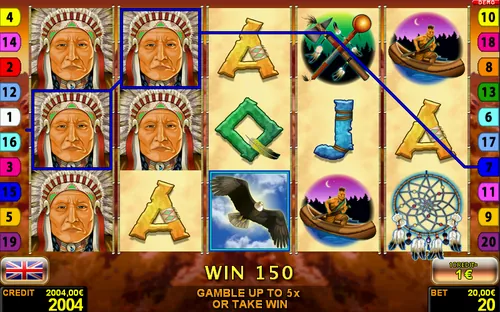
Bankroll rules that hold up
A sustainable bankroll for Indian Spirit should cover at least 100 times the maximum line stake to withstand potential losing streaks inherent in medium volatility games. For instance, if the max line bet is 5 €, a minimum bankroll of 500 € provides sufficient buffer against variance without risking rapid ruin. This mathematical foundation prevents emotional decision-making when facing inevitable dry spells during gameplay sessions.
Flat betting maintains a constant stake per round, avoiding the pitfalls of progressive staking systems that raise bets after losses. Since Indian Spirit’s RTP remains fixed at 95.34%, increasing wagers does not alter the built-in house edge but accelerates capital exhaustion. Consistent stakes allow for accurate tracking of win/loss ratios over time, providing clearer insights into actual performance versus theoretical expectations.
The welcome bonus offers 300% match funds up to 2,000 € plus 100 free spins, effectively multiplying initial deposit power by four. However, wagering requirements typically apply to these bonus funds, necessitating careful calculation of turnover obligations before withdrawal eligibility. Players must verify specific terms to ensure that playing Indian Spirit contributes appropriately toward meeting these mandatory volume thresholds.
Bet sizing against volatility
Medium volatility in Indian Spirit balances risk and reward, suggesting bet sizes that preserve bankroll while allowing participation in bonus triggers. Setting stakes between 0.20 € and 10 € per line enables extended playtime without exposing funds to excessive variance spikes. This range accommodates both conservative players seeking longevity and those willing to accept higher risk for potentially larger payouts during feature rounds.
The Dream catcher Wild and flying eagle Scatter symbols drive key mechanics, with three scatters awarding ten free spins. During these bonus rounds, additional symbols may enhance payout potential, making strategic bet sizing crucial for maximizing value. Higher stakes during base game play can amplify returns when features activate, though they also increase exposure to non-winning spins prior to trigger events.
Comparing Indian Spirit to Sizzling Hot Deluxe reveals differences in max win caps; the latter offers 5000x multiplier potential. While Indian Spirit lacks explicit max win data, its medium volatility profile suggests more frequent but smaller wins compared to high-cap titles. Adjusting bet levels accordingly ensures alignment with personal risk tolerance and desired payout frequency patterns.
Session limits worth setting
Establishing a time limit of two hours per session helps maintain discipline and prevents fatigue-induced errors when playing Indian Spirit. With an average spin duration of approximately three seconds, this timeframe allows for roughly 2,400 spins, providing ample opportunity to experience various game states. Monitoring elapsed time ensures that decisions remain rational rather than driven by frustration or euphoria during prolonged engagement.
Setting a loss limit equal to 20% of the total bankroll protects against catastrophic financial damage during unlucky streaks. If the bankroll stands at 1,000 €, a 200 € loss cap restricts downside exposure while preserving capital for future sessions. This rule enforces objective boundaries, preventing the common tendency to chase losses beyond affordable levels in pursuit of recovery.
Win goals should be defined as 50% profit above starting balance, triggering automatic session termination upon achievement. Reaching such targets locks in gains and avoids the psychological trap of giving back winnings during subsequent spins. This exit strategy complements loss limits, creating a balanced framework that prioritizes capital preservation and controlled enjoyment over unbounded speculation.
Why chasing losses fails
Chasing losses contradicts the fundamental principle that each spin in Indian Spirit is an independent event governed by random number generation. Previous outcomes have no influence on future results, meaning no amount of increased betting can restore lost funds or guarantee upcoming wins. Accepting this reality prevents destructive behavior patterns that stem from misconceptions about probability and control over chance-based systems.
The 4.66% house edge ensures that, over time, the casino retains a portion of all wagers placed on Indian Spirit. Attempting to overcome this mathematical advantage through aggressive betting strategies inevitably leads to faster bankroll depletion due to compounding risks. Recognizing the inevitability of long-term negative expectation encourages responsible gambling habits focused on entertainment value rather than profit generation.
Progressive staking methods like Martingale fail because table limits and finite bankrolls prevent infinite doubling after consecutive losses. Even with Indian Spirit’s medium volatility, extended losing sequences are statistically probable and will eventually breach any predefined betting progression. Sustainable play requires accepting variance as an intrinsic component of slot gaming rather than attempting to engineer predictable outcomes through flawed logic.
Indian Spirit: key facts
| Parameter | Value |
|---|---|
| Game | Indian Spirit |
| Studio | Novomatic |
| RTP | 95.34% |
| House edge | 4.66% |
| Volatility | medium |
| Reels | 5 reels |
| Paylines / ways | 20 fixed paylines |
Common systems and their limits
The theoretical RTP of Indian Spirit stands at 95.34%, establishing a house edge of 4.66% over extended play sessions. This percentage defines the long-term statistical return, contrasting sharply with short-term volatility where results fluctuate wildly around the mean. Players cannot alter this mathematical advantage through any betting strategy, as each spin remains an independent event governed by random number generation algorithms.
Sizzling Hot from Novomatic offers a slightly higher RTP of 95.66%, yet both titles share medium volatility characteristics that dictate payout frequency. The difference of 0.32% in return rates is negligible for individual sessions but accumulates significantly over millions of spins. Understanding these fixed parameters prevents players from chasing losses with ineffective systems, recognizing that no method can overcome the built-in house edge.
Flat betting explained
Flat betting requires maintaining the same stake amount on every single spin throughout the entire gaming session. This approach preserves bankroll stability by avoiding the rapid depletion associated with aggressive progression strategies after losing streaks. With Indian Spirit featuring twenty fixed paylines, consistent wagering allows players to endure the medium volatility without risking total financial ruin prematurely.
This method contrasts with progressive staking, which increases bets after losses and accelerates the time to ruin despite unchanged odds. By keeping stakes constant, players experience fewer extreme swings in their balance compared to those using variable betting patterns. The 95.34% RTP ensures that flat betting provides a predictable decay rate, allowing for longer entertainment periods within a predetermined budget limit.
Progressive staking risks
Progressive staking involves raising the bet size after each loss, a tactic that mathematically guarantees eventual bankroll exhaustion against a finite house edge. This strategy does not improve winning probability because the underlying game mechanics remain unchanged regardless of the current wager amount. Players attempting to recover losses quickly often exceed table limits or deplete funds before achieving a successful outcome.
The maximum win cap for similar Novomatic titles like Sizzling Hot is 5000x, yet progressive systems rarely reach such highs due to stake inflation. Increasing bets during dry spells amplifies variance negatively, turning moderate downswings into catastrophic losses much faster than flat betting would. The 4.66% house edge ensures that every unit wagered carries an expected loss, making recovery strategies statistically futile over the long term.
What the maths actually allows
The 95.34% RTP indicates that for every hundred euros wagered on Indian Spirit, approximately ninety-five euros are returned to players over time. This calculation assumes infinite spins, meaning short sessions will deviate significantly from this average due to the inherent randomness of slot machines. Players should view this figure as a long-term expectation rather than a guarantee for any specific playing session or hour of gameplay.
With medium volatility, wins occur with moderate frequency and size, balancing the risk of long dry spells against substantial payouts. The presence of features like the Dream catcher Wild and flying eagle Scatter adds complexity to the base game mathematics. These elements influence hit frequency but do not alter the fundamental 95.34% return rate established by the game developer Novomatic.
Reading variance honestly
Medium volatility in Indian Spirit means players will experience a balanced mix of small, frequent wins and occasional larger payouts. This characteristic differs from high-variance slots that produce long droughts followed by massive hits, requiring a substantially larger bankroll to survive. Understanding this distribution helps set realistic expectations regarding how often and how much money might be won during a typical session.
The bonus round triggers ten free spins when three or more Scatters appear, adding scatter symbols that enhance potential returns. While these features provide excitement, they operate within the same 95.34% RTP framework governing the base game outcomes. Players must recognize that bonus events are part of the overall mathematical model and do not offer separate or improved odds outside the stated return percentage.
Learning the game in demo first
Novomatic provides Indian Spirit as a five-reel slot with twenty fixed paylines, allowing players to verify the Dream catcher Wild and flying eagle Scatter mechanics without financial risk. This layout supports a theoretical return of 95.34% over extended play, which establishes a house edge of 4.66% for all eventual outcomes. Testing the bonus trigger for ten free spins on three or more scatters helps users understand how added symbols function before committing real funds.
The medium volatility rating indicates that win frequency balances between small regular payouts and larger occasional hits, unlike high-variance titles such as Alles Spitze by Merkur which features a much higher risk profile. Players can observe how the Native American theme integrates with these mathematical parameters through repeated demo sessions. Understanding this rhythm prevents misaligned expectations regarding payout consistency during actual gameplay.
Comparing the 95.34% RTP against Alles Spitze’s 90.85% reveals a significant difference in long-term retention rates, highlighting why demo mode is essential for accurate assessment. The lower edge in Indian Spirit suggests better preservation of bankroll over thousands of spins compared to the Merkur alternative. Such comparisons rely entirely on the published statistical data rather than subjective impressions of gameplay flow.
Adjusting stakes to your budget
Flat betting requires maintaining the same stake every round, which preserves the built-in 4.66% house edge while minimizing variance in bankroll depletion. This strategy contrasts sharply with progressive staking methods that raise stakes after losses, a technique that only accelerates the time to ruin without altering the mathematical disadvantage. Consistent wagering allows players to endure the medium volatility inherent in Novomatic’s design more effectively.
The welcome bonus offers a 300% match up to €2,000 plus 100 free spins, creating a substantial initial buffer for testing various stake levels safely. A player depositing €2,000 receives an additional €6,000 in bonus funds, totaling €8,000 available for wagers across the twenty fixed paylines. This expanded capital enables longer exploration of the game’s mechanics under different betting scenarios without immediate financial pressure.
Calculating the turnover requirement involves multiplying the bonus amount by the specified multiplier, ensuring players meet the conditions before withdrawing winnings derived from the free spins or matched funds. For instance, a €1,000 bonus portion might require specific volume thresholds depending on the operator's exact terms attached to the 100 free spins component. Managing this volume relative to the base stake ensures compliance while respecting the overall budget constraints established initially.
Recognising a bad session
A session becomes problematic when the bankroll depletes faster than the expected rate dictated by the 4.66% house edge and medium volatility settings. If a player experiences rapid loss cycles that ignore the statistical average, it signals either excessive stake sizing or unfortunate short-term variance unrelated to the game's true mathematics. Monitoring the speed of fund reduction helps identify when the current approach is unsustainable regardless of future potential reversals.
Contrast this with Alles Spitze, which carries a high volatility profile and a max win cap of 500x, meaning its loss patterns differ significantly from Indian Spirit’s more balanced distribution. While both games utilize fixed payline structures, the Merkur title demands greater tolerance for dry spells due to its aggressive risk structure. Recognizing these distinct profiles prevents applying incorrect endurance strategies to Novomatic’s medium-variance environment.
Tracking the number of spins relative to the starting bankroll provides a clear metric for session health, especially given the 95.34% theoretical return parameter. If the balance drops below a critical threshold after a standard number of spins, continuing to play increases the probability of total loss without improving odds. Stopping at this point preserves remaining funds for future attempts where conditions may be more favorable.
Stopping while ahead
Setting a profit target based on the initial bankroll allows players to lock in gains before the 4.66% house edge inevitably erodes positive results over time. Since Indian Spirit operates with medium volatility, significant wins are possible but not guaranteed in every session, making early withdrawal a prudent defensive measure. Securing profits ensures that the temporary advantage gained during a lucky streak translates into actual retained value rather than hypothetical potential.
The 100 free spins included in the welcome bonus offer a separate avenue for generating additional funds without risking personal capital, provided wagering requirements are met. Any winnings from these spins must typically be converted through further play, adding complexity to the decision of when to exit the game entirely. Separating bonus-derived income from deposited funds helps clarify whether a session is genuinely profitable or merely cycling promotional credit.
Unlike Alles Spitze with its high volatility and 500x max win limit, Indian Spirit’s payout structure favors consistent engagement over massive single-hit jackpots. This distinction influences the optimal stopping point, as chasing large wins in a medium-variance game often leads to giving back accumulated profits. Defining a clear exit strategy based on predetermined monetary goals protects the player from the psychological trap of expecting exponential growth.
Responsible play in practice
Defining bankroll as the money set aside specifically for entertainment purposes ensures that essential living expenses remain untouched during gaming activities. This separation creates a hard boundary that prevents emotional decision-making from compromising financial stability, regardless of the 95.34% RTP or any other statistical metric. Treating gambling costs like any other leisure expense maintains perspective and reduces the likelihood of problematic behavior emerging from misplaced hopes.
Players should expect periods of no returns interspersed with smaller wins, a pattern inherent to the twenty fixed paylines and five-reel configuration. Accepting this reality prevents frustration-driven decisions that contradict responsible gaming principles and rational bankroll management strategies.
Monitoring time spent playing alongside financial outlays helps maintain awareness of the activity’s impact on daily life and mental well-being. Unlike crash games with cash-out buttons, slots like Indian Spirit require continuous engagement until a stop decision is made, increasing the risk of autopilot behavior. Setting strict time limits complements financial boundaries, ensuring that the experience remains controlled and within safe parameters defined by the player.
DemoRTP & VolatilitySymbols & PayoutsBonus FeaturesStrategyBonusesMobileDownload & AppMax WinSimilar GamesReviewFAQSitemap
Indian Spirit 2026